

Borrowing from abroad that which does not yet grow on native soil

The Russian Empire (or Empire of Russia) was a state that existed from 1721 to 1917 in Eastern Europe, Central Asia and North America. The country was the largest contiguous empire in modern history in the mid-19th century. It was dissolved after the February Revolution in 1917. The state was regarded as autocratically ruled and was inhabited by about 181 million people.
Popular enlightenment turns into counter-enlightenment
The first Estonian newspaper and the Reading revolution
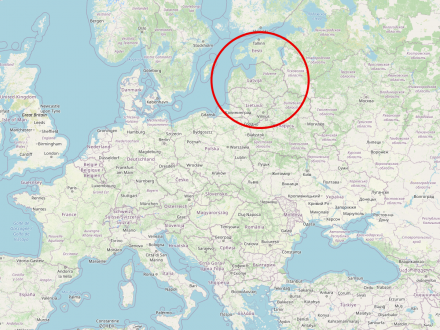
The Baltic States is a region in the north-east of Europe and is composed of the three states Estonia, Latvia and Lithuania. The Baltic States are inhabited by almost 6 million people.


The author of the Estonian national epic, “Kalevipoeg”, Friedrich Reinhold Kreutzwald as translator

Tartu (population 2024: 96,506) is the second largest city in Estonia. It is located in the southeast of the country and thus in the north of the historical landscape of Livonia. Tartu lies roughly halfway between the country's two largest lakes, Võrtsjärv and Peipus, the latter of which Estonia shares with the Russian Federation.
Tartu has been for centuries an important transportation hub and traditional center of learning. It is famous for its university, which was founded in 1632, under Swedish rule. It is still the largest university in Estonia and a member of the Coimbra Group, a network of particularly traditional and internationally outstanding European universities. Tartu is also home to numerous museums, including the Estonian National Museum and the Estonian Literature Museum.

The dominance of German


These accusations and justifications marked the end of a dialogue between the Baltic-German and the Estonian intellectual elite on the subject of literary translation.
The new generation of Estonian translators
The research work at the basis of this article was supported by the Estonian Research Council’s grant PRG1206 “Translation in History, Estonia 1850-2010: Texts, Agents, Institutions and Practices”.
