The archaeological site files from the former East Prussia constitute a unique collection of sources on the province’s archaeological monuments dating back to the 19th century. Thanks to transcription and digital presentation, these handwritten files are now accessible.
Kaliningrad (Bevölkerungszahl 2024: 488.690) ist die einzige Großstadt in der russischen Exklave Oblast Kaliningrad, die ungefähr dem nördlichen Teil der preußischen Provinz Ostpreußen vor 1945 entspricht. Königsberg war nicht nur die Hauptstadt der Provinz und die nordöstlichste Großstadt Preußens, sondern ab 1724 auch Königliche Haupt- und Residenzstadt in Preußen. Heute ist Kaliningrad ein wichtiger Hafen- und Industriestandort sowie ein bedeutender Ort für Kultur und Wissenschaft.
in East Prussia,” based at the Museum of Prehistory and Early History (MVF) in Berlin, focused on a scientifically unique and particularly valuable archival collection from the former East Prussia. The Prussia Museum in Königsberg held one of the most important prehistoric and early historic archaeological collections for the Baltic region and beyond. In the aftermath of the Second World War, the collection was scattered. Documents and archaeological finds became separated from their original contexts, and some were damaged or destroyed. For many years, researchers assumed that these unique holdings had been completely lost. It was only after the political changes of the 1990s that it became clear that substantial parts of the collection had survived in Berlin. Smaller holdings of the Prussia Museum are also preserved in
The city of Olsztyn (population 2022: 168,212) was founded in 1353 as Allensteyn on the Łyna river. Olsztyn is the largest city in Warmia and the capital of the Warmian–Masurian Voivodeship. The city is member of the European Route of Brick Gothic, especially because of its Old Town market sqare and the Castle of Warmian Cathedral Chapter.
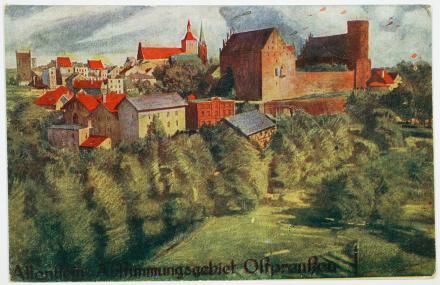
The picture shows a city view of Olsztyn /Allenstein on a postcard from before 1945.
, Poland, Kaliningrad, Russia, and elsewhere. Since its rediscovery, the collection has been gradually reconstructed and made accessible for research.
The so-called “Site Archive” contains documentation of archaeological monuments in East Prussia. It was an important part of the Königsberg collection. Today, the archive is held in Berlin in trust. As part of the review and reconstruction carried out there, the documents were reorganized into 2,184 files. The files contain information on more than 2,000 sites throughout the province, arranged alphabetically from A to Z. Each site covers a larger area that may contain one or more archaeological find locations. These sites – including burial grounds, hillforts, hoards and individual finds – date from various periods, from the Stone Age to the modern era. The aim of the project was to produce accurate transcriptions of the files, systematically record and index their contents, and make them available digitally.
The documents in the Königsberg Site Archive date from 1826 to 1943 and are written in German. Most were handwritten, though some were typed. Most of the authors were scholars and other employees of the state and municipal institutions of the period. The files also contain contributions from landowners, teachers, pastors and civil servants who were involved in the study and preservation of the region’s archaeological heritage, either through organizations such as the Physical-Economic Society and the Prussia Society of Antiquities or in an honorary capacity as so-called “district conservators.” They frequently reported archaeological finds and sites.
Taken as a whole, the documents contain a wealth of archaeological knowledge that has yet to be fully explored. Only a small number of the sites discovered in the nineteenth and first half of the twentieth centuries have been documented in detail. Even a site that was famous at the time, such as the Viking cemetery at Kaup near Wiskiauten in Samland, now located in the Kaliningrad region, was described several times in the daily press but never received substantial scholarly treatment at the time. Beyond archaeology, the records offer enormous potential for uncovering facts and details about cultural life in the region from the early nineteenth century onwards. The people involved at different levels, and their individual motivations for studying local antiquities, come vividly to life in the records. The documents also allow the development of the discipline's increasing professionalization to be traced, as well as the political instrumentalization of archaeology and regional history from at least the 1930s onwards.
More than two-thirds of the documents are written in German Kurrent, Sütterlin or Latin cursive script. For many researchers today, particularly younger ones, Kurrent and Sütterlin are no longer readily legible. The often poor condition of the papers, together with idiosyncratic handwriting, makes deciphering these texts even more difficult. To make such documents accessible to a wider range of users, volunteers at the Berlin Museum of Prehistory and Early History transcribed the Site Archive and entered the transcriptions into digital text files. The resulting raw transcriptions were then editorially standardized and reviewed by subject specialists as part of the project. Since 2025, they have been available, together with digitized versions of the original documents, in the “Prussia Museum Digital” database.
The Site Archive of the Königsberg Prussia Museum constitutes an important body of sources on Germany’s cultural heritage, which this project has now made more directly accessible to national and international researchers. This is important not only for modern archaeological heritage management in the countries that now occupy the territory of the former East Prussia, but also for university research and the museum presentation of the region’s diverse archaeological remains and, with them, its rich and varied history.